

Innovation Begins with Education
Dr Gareth Robinson Engaged Research Lead, QCAP Medellín QCAPture Series 4/6
Gareth is a Senior Research Fellow at Queen’s Communities and Place (QCAP), leading the Education, Skills and Inclusive Innovation dimension. His work examines how education, civic learning and innovation investment shape urban futures, with a particular focus on working-class communities’ participation in the knowledge economy. He is the academic lead for the Innovate UK-funded Belfast Community Research and Innovation Network (BCRIN) and leads QCAP’s work with the South Belfast Primary Schools Partnership, supporting locality-based collaboration and practitioner enquiry as forms of learning infrastructure. His previous work includes contributions to the ESRC-funded Excluded Lives project on disparities in school exclusion across the UK and work on the development of Shared Education through the School of Social Sciences, Education and Social Work at Queen’s University Belfast.

A couple of years ago, the World Bank set out the importance of education for innovation-led economies. It’s widely acknowledged that education is a prerequisite for innovation; it builds skills that increase productivity; it supports the adoption of new technologies; and it strengthens the innovative human capital available to organisations. That framing is not novel, but Medellín made it feel less like an abstract proposition and more like something that can be built into the everyday design of an innovation ecosystem.
One of the first things that struck me was the visibility of learning space within what we would normally label innovation infrastructure. Under one of the metro cable car stations, we saw a learning hub with library-type provision embedded within the station footprint. It did not appear to be an afterthought. There was deliberate thinking about how innovation infrastructure can add to the intellectual assets available to communities, in situ, in ways that reduce the distance (and the intimidation factor) between “innovation” and everyday life.
That kept pulling me back to the question of enabling assets. In the collaborative innovation literature, Jacob Torfing uses the language of “innovation assets” to foreground the resources and capacities that make innovation possible across a system (Torfing, 2019). Medellín prompted me to ask a related question in my own terms: what are the enabling assets of inclusive innovation—by which I mean innovation whose direction, benefits, and capability-building are not confined to already-advantaged actors, but are shaped and distributed with communities? Part of what we saw was the use of technology for the activation of public space—practical demonstrations, interactive environments, learning-oriented installations. One purpose of inclusive innovation may be exactly that: not simply producing new products, but producing conditions in which people can encounter ideas, tools, and learning opportunities as part of daily civic life. Parque Explora, from what we observed, seemed to function as a thought leader in this space—both as a public-facing institution and as a source of expertise on how to design and co-create these kinds of learning-oriented civic environments.
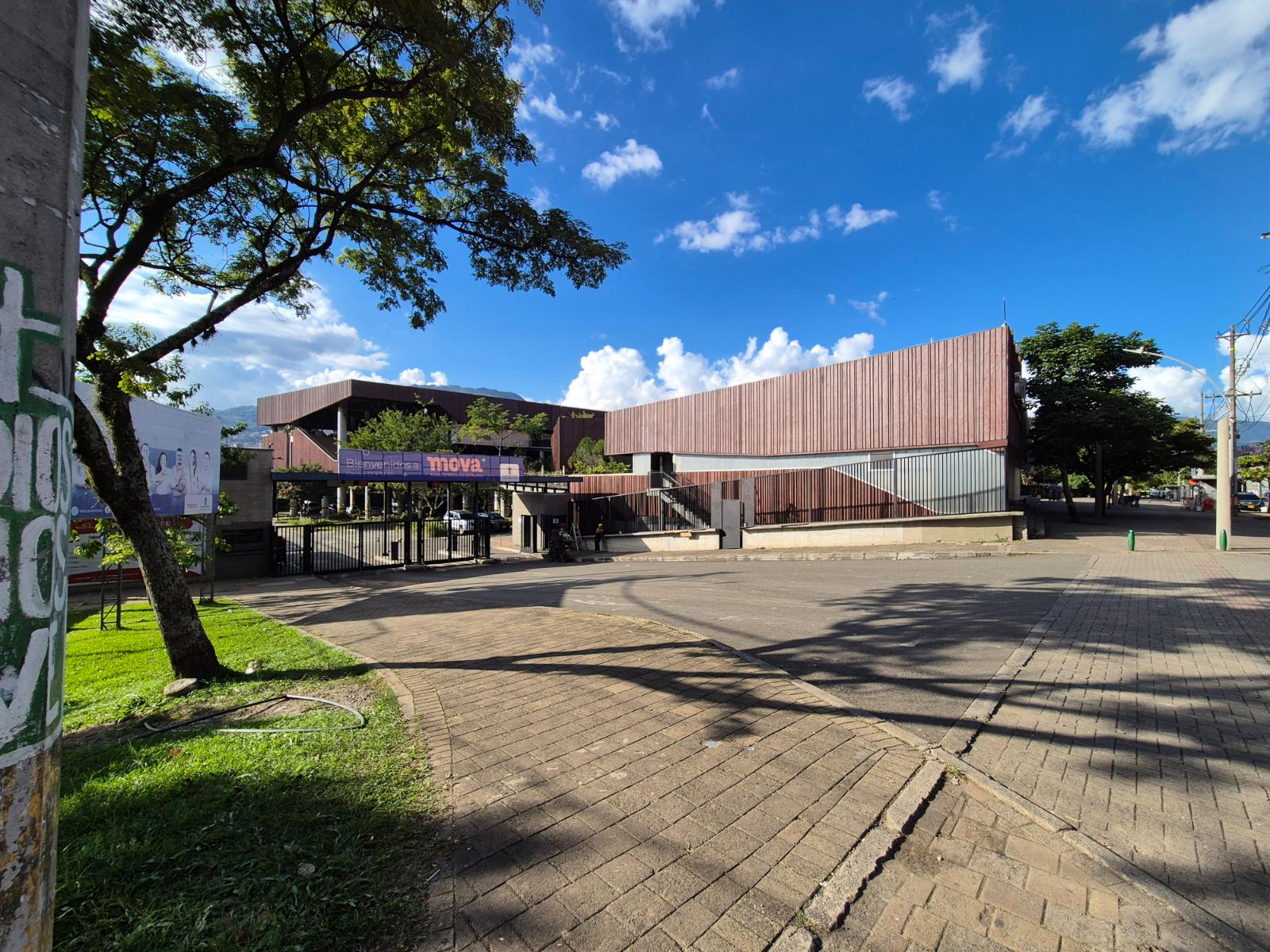
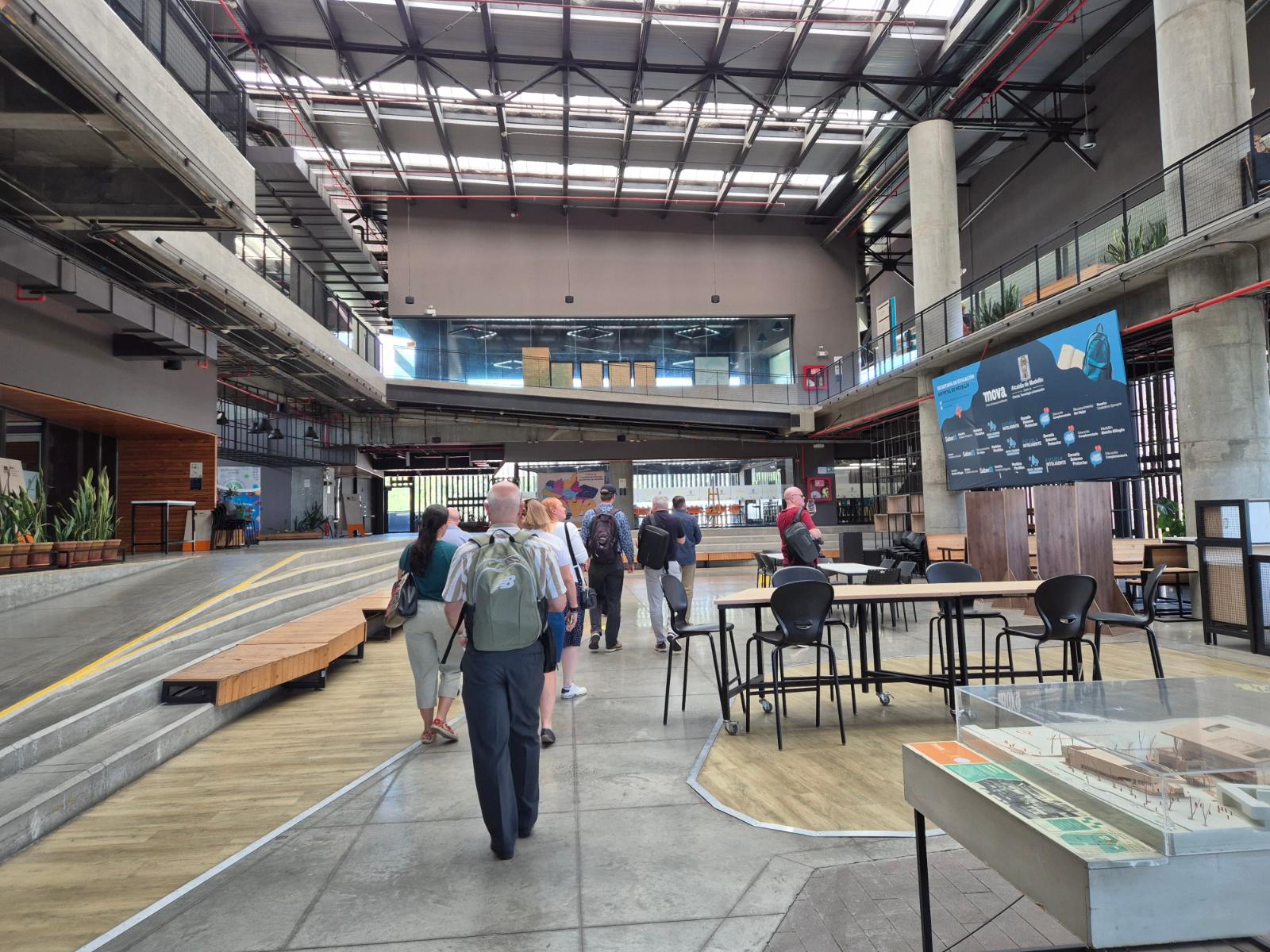
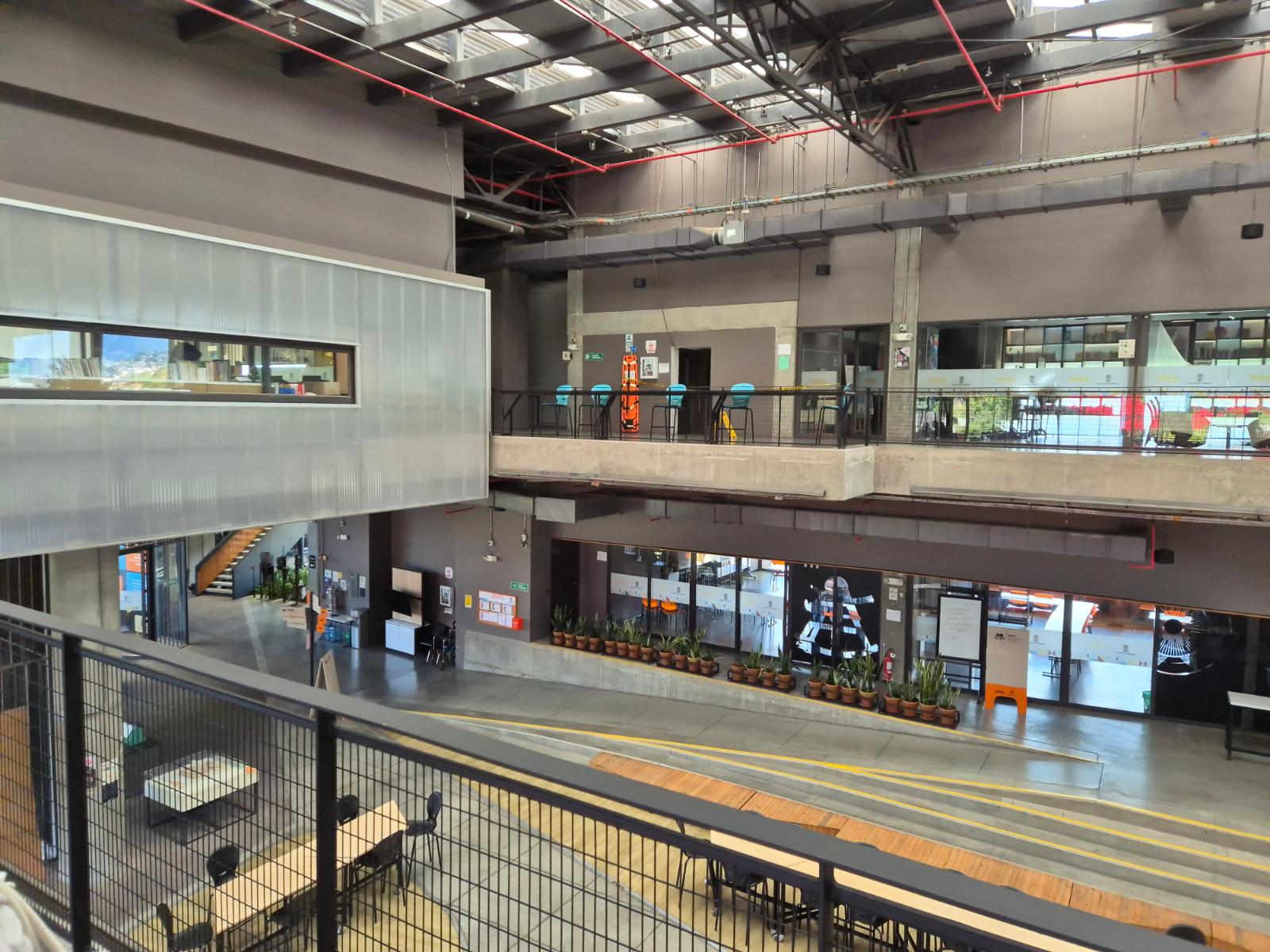
MOVA brought the education dimension of this into sharp focus. It is, in the most literal sense, a bricks-and-mortar commitment to the professional learning of teachers across the city. It is a teacher innovation centre affiliated with the Secretaría de Educación supporting 19 school networks across a public system of roughly 229 schools—some, we were told, enrol around 5,000 pupils—and approximately 10,000 teachers, with collaboration largely voluntary rather than driven by a formal policy imperative. The point here is not that Medellín “does more CPD” than Belfast. There have always been examples of good CPD at home in some shape or form, and more recently emerging pathways for practitioner enquiry as a basis for professional learning. The point is that MOVA positions teacher professional learning as part of their innovation ecosystem’s core infrastructure, and it links that learning to the wider innovation agenda with unusual intentionality. Teachers are not peripheral actors; they are key architects of a region’s skills profile and, therefore, an important pillar of an innovation ecosystem—albeit one that is rarely acknowledged in innovation discourse.
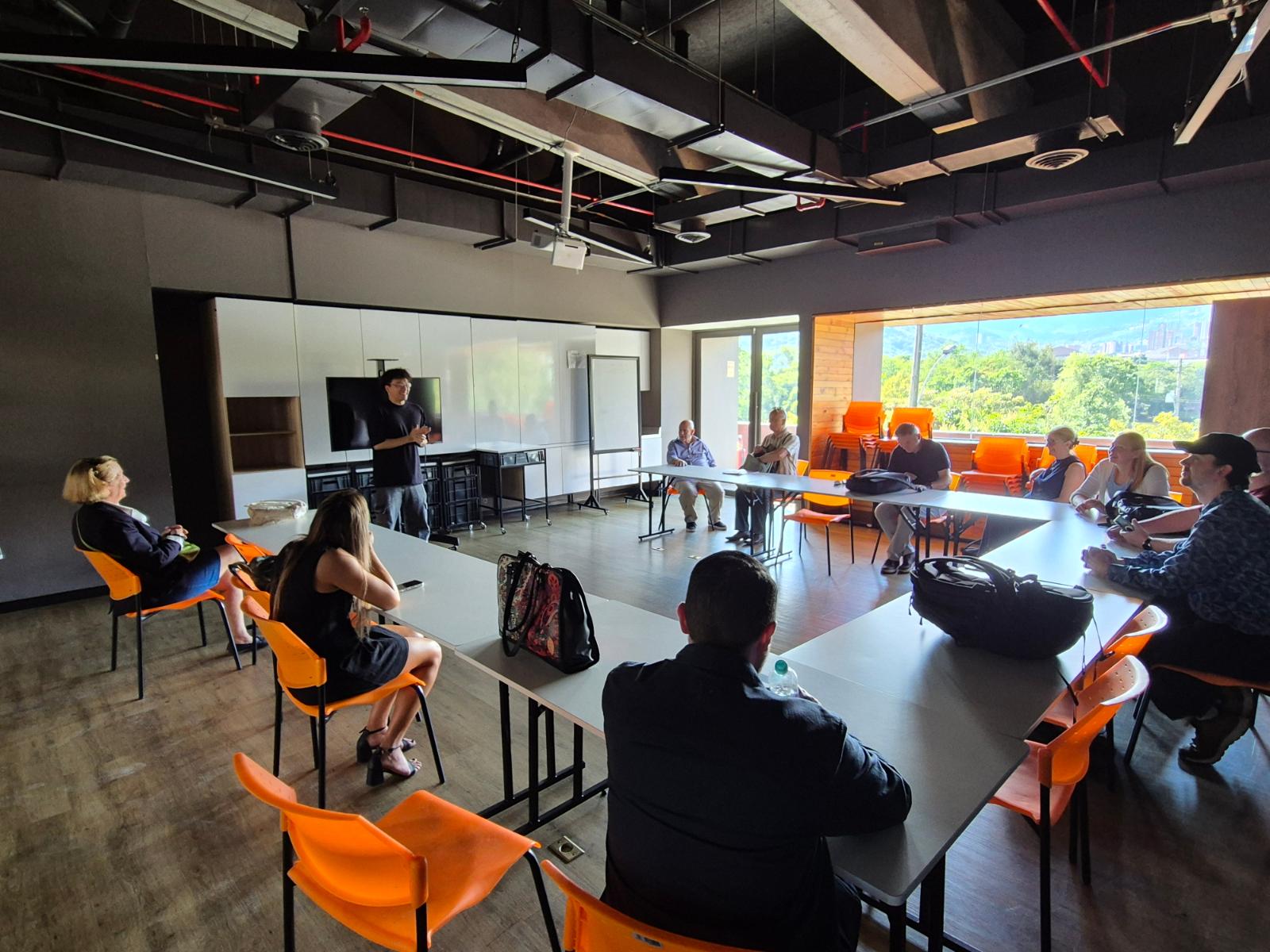
The detail that stayed with me from my notes is the way MOVA invites teachers to submit practice-based “research” proposals for programme development. Teachers are treated as place-based experts on problems and approaches and supported to collaborate through enquiry cycles that aim to improve education across the city. The quietly radical element is what follows: as the MOVA team described, proposals are selected and developed where they align most strongly with the “missions” connected to Ruta N. This is alignment as an active design principle: connecting teachers’ work to a wider set of civic priorities and making those connections through concrete selection and development processes rather than through vague partnership language.
That matters because alignment and coherence are not only curriculum concerns. Any coherent curriculum depends on alignment between aims, content, pedagogy, and assessment. I would argue the same is true for an inclusive innovation ecosystem: if there is not alignment across education, intermediaries, investment priorities, community infrastructures, and civic missions, then complexity becomes disjointed activity. Inclusivity becomes performative—lots of touchpoints, little cumulative capability.
MOVA also claimed to be running a programme of action research, evaluation, and learning involving support from 89 research centres. I am less interested in the headline number than in what it implies: a deliberate attempt to create systemic intersections across which knowledge, ideas, and different forms of capital can flow. That is what ecosystems actually require: making institutional boundaries more porous through brokerage and repeated routines of exchange and joint work—an approach we learned the value of during Shared Education—rather than isolated projects that burn bright and then move on.
Belfast and Northern Ireland have meaningful activity that connects education and youth engagement to innovation sectors. Catalyst, W5 Life, bytes, Sentinus, and others are doing serious work. The constraint I keep coming back to is structural. Much of our activity is cohort-based or project-based: offer a programme to a set of schools, deliver it for those that opt in, conclude, then shift to the next cohort. That can be worthwhile, but it does not easily build shared learning infrastructure across a locality over time. It is also fragile: dependent on individual champions and short-term resourcing.
This sits alongside a harder question about the purpose of education within an innovation agenda. Is the point to drive everyone towards advanced qualifications and skilled labour for the economy? Or does education serve democratic purposes as well—an instrument for critical consciousness, for contesting imposed development trajectories, for resisting gentrification, ill health, poverty, and the steady normalisation of underachievement in some places? In cities like Medellín and Belfast, educational inequality is not merely an education problem; it is a constraint on innovation capacity, and a constraint on agency.
If education is to serve democratic purposes within an innovation agenda, literacy is one of the key mechanisms through which agency is distributed. Literacy, in the broadest sense, is also social infrastructure because it shapes who can participate in meaning-making and collective action. Freire’s argument in Pedagogy of the Oppressed was that literacy is not merely an important competence but a political capability: learning to “read the word” is bound up with learning to “read the world”, and with developing the critical consciousness needed to question and reshape the conditions that structure everyday life. The contemporary analogue is not print literacy alone, but the capabilities required to engage with digital, data, and research infrastructures that increasingly determine who can interpret, challenge, and influence dominant innovation agendas.
Back home in Belfast, we are dealing with skills shortages, economic inactivity, and persistent educational inequalities. We also have examples of poor alignment within the system education itself. ICT in primary is a stark illustration from our own work: weak curriculum coherence leaves schools in the same locality teaching different content and using different assessment materials, producing unintended inequities for pupils and avoidable discontinuities when they transition into post-primary. ICT coordinators have told us that by the time a cohort moves into Year 9, a single class can include pupils with markedly different levels of understanding of key concepts, creating immediate challenges for teaching and progression.
The TransformED NI strategy for educational reform affords us an opportunity to do the clever thing and think long term about what society here needs, including a bedrock of innovation. There are, however, a lot of yet-to-be-knowns about how it will roll out and how schools will be supported to do it. One of the more promising aspects is the development of research capacity and the use of evidence across the system, which one can only hope will bring a culture of innovation to a system that has been thirsty for new ideas and motivations. But we are missing the advantage of one strategic lever building on another. The Belfast Region City Deal is the obvious example. It has backed major physical infrastructure across the city, with several innovation centres, and it will leave a real legacy. But its skills pillar has not been treated as equally integral to the innovation investment priorities. In Medellín, we saw skills, learning, and capability-building designed into the ecosystem; in Belfast, that has not landed with anything like the same weight or visibility as the capital builds.
So the Medellín takeaway, from my perspective, is not “copy MOVA”, but three things: (1) the need to treat teacher learning as infrastructure—stable, properly resourced, teacher-led, and connected to wider civic and innovation priorities rather than delivered as intermittent provision. That same logic points to an immediate issue in Northern Ireland: (2) the Department of Education and the Department for the Economy need to align more deliberately, because at present education and innovation policy too often proceed in parallel. And finally (3) the value of building intentional interfaces—places, roles, and routines that repeatedly bring actors together—so cross-system work becomes normal practice.
Spending time in Medellín and seeing this work up close with i3o was a genuine privilege, and I am grateful to the colleagues and partners who hosted us, shared their thinking so openly, and took the time to walk us through what they have been building.